Dinoglyphs


Evolution of Apple MacIntosh

Descent of Apple MacIntosh Logos
Apple MacIntosh programs in a historical timeline


Wikipedia
Founded Cupertino, California, United States (April 1, 1976)
as Apple Computer, Inc.
Founder(s) Steve Jobs, Steve Wozniak, Ronald Wayne[1]
Headquarters 1 Infinite Loop, Cupertino, California, USA
Number of locations 284[2] (January 2010)
Area served Worldwide; United States, United Kingdom, Canada, Japan, Australia,
India, Switzerland, Italy, Germany, and China
Key people Steve Jobs (CEO, Chairman, and co-founder) Tim Cook (COO) Peter
Oppenheimer (CFO) Phil Schiller (SVP Marketing) Jonathan Ive (SVP Industrial
Design) Mark Papermaster (SVP Device Engineering) Ron Johnson (SVP Retail) Sina
Tamaddon (SVP Applications) Bertrand Serlet (SVP Software Engineering) Scott
Forstall (SVP iPhone Software)
Industry Computer hardware · Computer software Consumer electronics · Digital
distribution
Products Mac (Pro, Mini · iMac · MacBook, Air, Pro · Xserve) iPhone, iPad, iPod
(Shuffle, Nano, Classic, Touch) Apple TV, Cinema Display, AirPort, Time Capsule
Mac OS X (Server · iPhone OS), iLife, iWork
Services Stores (retail, online, iTunes, App, iBooks), MobileMe
Revenue ▲US$42.91 billion[3] (FY 2009)
Operating income ▲$11.74 billion[3] (FY 2009)
Net income ▲$ 8.24 billion[3] (FY 2009)
AUM ▲$26.83 billion[4] (FY 2009)
Total assets ▲$47.50 billion[4] (FY 2009)
Total equity ▲$31.64 billion[4] (FY 2009)
Employees ▼34,300[5] (FY 2009)
Subsidiaries Braeburn Capital, FileMaker Inc.
Website Apple.com
Apple Inc. is an American multinational corporation that designs and
manufactures consumer electronics, computer software, and commercial servers.
The company's best-known hardware products include Macintosh computers, the
iPod, the iPhone and the iPad. Apple software includes the Mac OS X operating
system; the iTunes media browser; the iLife suite of multimedia and creativity
software; the iWork suite of productivity software; Aperture, a professional
photography package; Final Cut Studio, a suite of professional audio and
film-industry software products; and Logic Studio, a suite of audio tools. As of
January 2010 the company operates 284 retail stores[2] in ten countries,[6] and
an online store where hardware and software products are sold.
Established in Cupertino, California on April 1, 1976 and incorporated January
3, 1977,[7] the company was called Apple Computer, Inc. for its first 30 years,
but dropped the word "Computer" on January 9, 2007[8] to reflect the company's
ongoing expansion into the consumer electronics market in addition to its
traditional focus on personal computers.[9] Apple has about 35,000 employees
worldwide[10] and had worldwide annual sales of US$42.91 billion in its fiscal
year ending September 26, 2009.[3] For reasons as various as its philosophy of
comprehensive aesthetic design to its distinctive advertising campaigns, Apple
has established a unique reputation in the consumer electronics industry. This
includes a customer base that is devoted to the company and its brand,
particularly in the United States.[11] Fortune magazine named Apple the most
admired company in the United States in 2008 and in the world in 2009.[12][13]
1976–1980: The early years
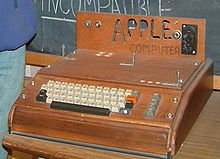
The Apple I, Apple's first product. Sold as an assembled circuit board, it
lacked basic features such as a keyboard, monitor, and case. The owner of this
unit added a keyboard and a wooden case.Apple was established on April 1, 1976
by Steve Jobs, Steve Wozniak, and Ronald Wayne,[1] to sell the Apple I personal
computer kit. They were hand-built by Wozniak[14][15] and first shown to the
public at the Homebrew Computer Club.[16] The Apple I was sold as a motherboard
(with CPU, RAM, and basic textual-video chips)—less than what is today
considered a complete personal computer.[17] The Apple I went on sale in July
1976 and was market-priced at $666.66 ($2.5 thousand in 2009 dollars, adjusted
for inflation.)[18][19][20][21][22][23]
Apple was incorporated January 3, 1977[7] without Wayne, who sold his share of
the company back to Jobs and Wozniak for $800. Multi-millionaire Mike Markkula
provided essential business expertise and funding of $250,000 during the
incorporation of Apple.[24][25]
The Apple II was introduced on April 16, 1977 at the first West Coast Computer
Faire. It differed from its major rivals, the TRS-80 and Commodore PET, because
it came with color graphics and an open architecture. While early models used
ordinary cassette tapes as storage devices, they were superseded by the
introduction of a 5 1/4 inch floppy disk drive and interface, the Disk II.[26]
The Apple II was chosen to be the desktop platform for the first "killer app" of
the business world—the VisiCalc spreadsheet program.[27] VisiCalc created a
business market for the Apple II, and gave home users an additional reason to
buy an Apple II—compatibility with the office.[27] According to Brian Bagnall,
Apple exaggerated its sales figures and was a distant third place to Commodore
and Tandy until VisiCalc came along.[28][29]
By the end of the 1970s, Apple had a staff of computer designers and a
production line. The Apple II was succeeded by the Apple III in May 1980 as the
company competed with IBM and Microsoft in the business and corporate computing
market.[30]
Jobs and several Apple employees including Jef Raskin visited Xerox PARC in
December 1979 to see the Xerox Alto. Xerox granted Apple engineers three days of
access to the PARC facilities in return for the option to buy 100,000 shares of
apple at the pre-IPO price of $10 a share.[31] Jobs was immediately convinced
that all future computers would use a graphical user interface (GUI), and
development of a GUI began for the Apple Lisa.[32]
In December 1980, Apple launched the initial public offering of its stock to the
investing public.[citation needed] When Apple went public, it generated more
capital than any IPO since Ford Motor Company in 1956 and instantly created more
millionaires (about 300) than any company in history. Several venture
capitalists cashed out, reaping billions in long-term capital gains.[
1981–1985: Lisa and Macintosh
The heroine from Apple's 1984 ad, set in a dystopian future modeled after the
George Orwell novel Nineteen Eighty-Four, set the tone for the introduction of
the Macintosh.Steve Jobs began working on the Apple Lisa in 1978 but in 1982 he
was pushed from the Lisa team due to infighting, and took over Jef Raskin's
low-cost-computer project, the Macintosh. A turf war broke out between Lisa's
"corporate shirts" and Jobs' "pirates" over which product would ship first and
save Apple. Lisa won the race in 1983 and became the first personal computer
sold to the public with a GUI, but was a commercial failure due to its high
price tag and limited software titles.[33]
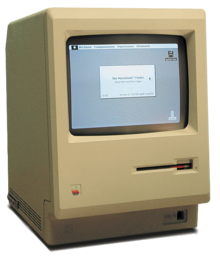
The first Macintosh, also known as the Macintosh 128K.In 1984, Apple next
launched the Macintosh. Its debut was announced by the now famous $1.5 million
television commercial '1984'. It was directed by Ridley Scott, aired during the
third quarter of Super Bowl XVIII on January 22, 1984,[34] and is now considered
a watershed event for Apple's success[35] and a "masterpiece".[36][37]
The Macintosh initially sold well, but follow-up sales were not strong.[38] This
was because of the again high price tag, as well as limited software titles. The
machine's fortunes changed with the introduction of the LaserWriter, the first
PostScript laser printer to be offered at a reasonable price point, and
PageMaker, an early desktop publishing package. The Mac was particularly
powerful in this market due to its advanced graphics capabilities, which were
already necessarily built-in to create the intuitive Macintosh GUI. It has been
suggested that the combination of these three products was responsible for the
creation of the desktop publishing market.[39]
In 1985, a power struggle developed between Jobs and CEO John Sculley, who had
been hired two years prior.[40] Apple's board of directors sided with Sculley
and Jobs was removed from his managerial duties.[38] Jobs resigned from Apple
and founded NeXT Inc. the same year.[41]
Apple's sustained growth during the early 1980s was in great part due to its
leadership in the education sector, attributed to an implementation of the LOGO
Programming Language by Logo Computer Systems Inc., (LCSI), for the Apple II
platform. The success of Apple and LOGO in the education environment provided
Apple with a broad base of loyal users around the world. The drive into
education was accentuated in California by a momentous agreement concluded
between Steve Jobs and Jim Baroux of LCSI, agreeing with the donation of one
Apple II and one Apple LOGO software package to each public school in the state.
The arrangement, eventually replicated in Texas, established a strong and
pervasive presence for Apple in all schools throughout California, that ignited
the acquisition of Apple IIs in schools across the country. The conquest of
education became critical to Apple's acceptance in the home, as parents
supported children’s continued learning experience after school.
1986–1993: Rise and fall
See also: Timeline of Apple II family and Timeline of Macintosh models
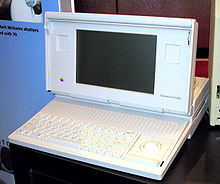
The Macintosh Portable was Apple's first "portable" Macintosh computer, released
in 1989.Having learned several painful lessons after introducing the bulky
Macintosh Portable in 1989, Apple introduced the PowerBook in 1991, which
established the modern form and ergonomic layout of the laptop computer.[42] The
Macintosh Portable was designed to be just as powerful as a desktop Macintosh
and turned out 17 pounds with a 12 hour battery life. Apple sold fewer than
100,000 units.[citation needed] The Powerbook was 7 pounds and had a 3 hour
battery life, and sold a billion dollars worth within the first year.[citation
needed] The same year, Apple introduced System 7, a major upgrade to the
operating system, which added color to the interface and introduced new
networking capabilities. It remained the architectural basis for Mac OS until
2001.
The success of the PowerBook and other products led to increasing revenue.[40]
For some time, it appeared that Apple could do no wrong, introducing fresh new
products and generating increasing profits in the process. The magazine
MacAddict has named the period between 1989 and 1991 as the "first golden age"
of the Macintosh.
Following the success of the Macintosh LC, Apple introduced the Centris line, a
low end Quadra offering, and the ill-fated Performa line that was sold in
several confusing configurations and software bundles to avoid competing with
the various consumer outlets such as Sears, Price Club, and Wal-Mart, the
primary dealers for these models. The result was disastrous for Apple as
consumers did not understand the difference between models.
During this time Apple experimented with a number of other failed consumer
targeted products including digital cameras, portable CD audio players,
speakers, video consoles, and TV appliances. Enormous resources were also
invested in the problem-plagued Newton division based on John Sculley's
unrealistic market forecasts. Ultimately, all of this proved too-little-too-late
for Apple as their market share and stock prices continued to slide.
Apple saw the Apple II series as too expensive to produce, while taking away
sales from the low end Macintosh.[43] In 1990 Apple released the Macintosh LC
with a single expansion slot for the Apple IIe Card to migrate Apple II users to
the Macintosh platform.[44] Apple stopped selling the Apple IIe in 1993.
Microsoft continued to gain market share with Windows, focusing on delivering
software to cheap commodity personal computers while Apple was delivering a
richly engineered, but expensive, experience.[45] Apple relied on high profit
margins and never developed a clear response. Instead they sued Microsoft for
using a graphical user interface similar to the Apple Lisa in Apple Computer,
Inc. v. Microsoft Corporation.[46] The lawsuit dragged on for years before being
thrown out of court. At the same time, a series of major product flops and
missed deadlines destroyed Apple's reputation and Sculley was replaced by
Michael Spindler.[47]
1994–1997: Attempts at reinvention
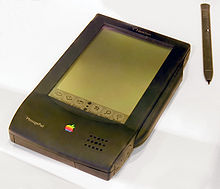
The Newton was Apple's first foray into the PDA markets, as well as one of the
first in the industry. A financial flop, it helped pave the way for the Palm
Pilot and Apple's own iPhone and iPad in the future.By the early 1990s, Apple
was developing alternative platforms to the Macintosh, such as the A/UX. The
Macintosh platform was becoming outdated since it was not built for
multitasking, and several important software routines were programmed directly
into the hardware. In addition, Apple was facing competition from OS/2 and UNIX
vendors like Sun Microsystems. The Macintosh would need to be replaced by a new
platform, or reworked to run on more powerful hardware.[48]
In 1994, Apple allied with IBM and Motorola in the AIM alliance. The goal was to
create a new computing platform (the PowerPC Reference Platform), which would
use IBM and Motorola hardware coupled with Apple's software. The AIM alliance
hoped that PReP's performance and Apple's software would leave the PC far
behind, thus countering Microsoft. The same year, Apple introduced the Power
Macintosh, the first of many Apple computers to use IBM's PowerPC processor.[49]
In 1996, Michael Spindler was replaced by Gil Amelio as CEO. Gil Amelio made
many changes at Apple, including massive layoffs.[50] After multiple failed
attempts to improve Mac OS, first with the Taligent project, then later with
Copland and Gershwin, Amelio chose to purchase NeXT and its NeXTSTEP operating
system, bringing Steve Jobs back to Apple as an advisor.[51] On July 9, 1997,
Gil Amelio was ousted by the board of directors after overseeing a three-year
record-low stock price and crippling financial losses. Jobs became the interim
CEO and began restructuring the company's product line.
At the 1997 Macworld Expo, Steve Jobs announced that Apple would join Microsoft
to release new versions of Microsoft Office for the Macintosh, and that
Microsoft made a $150 million investment in non-voting Apple stock.[52]
On November 10, 1997, Apple introduced the Apple Store, tied to a new
build-to-order manufacturing strategy.[53][54]
1998–2005: Return to profitability
Company headquarters on Infinite Loop in Cupertino, California.On August 15,
1998, Apple introduced a new all-in-one computer reminiscent of the Macintosh
128K: the iMac. The iMac design team was led by Jonathan Ive, who would later
design the iPod and the iPhone.[55][56] The iMac featured modern technology and
a unique design. It sold close to 800,000 units in its first five months and
returned Apple to profitability for the first time since 1993.[57]
Through this period, Apple purchased several companies to create a portfolio of
professional and consumer-oriented digital production software. In 1998, Apple
announced the purchase of Macromedia's Final Cut software, signaling its
expansion into the digital video editing market.[58] The following year, Apple
released two video editing products: iMovie for consumers, and Final Cut Pro for
professionals, the latter of which has gone on to be a significant video-editing
program, with 800,000 registered users in early 2007.[59] In 2002 Apple
purchased Nothing Real for their advanced digital compositing application
Shake,[60] as well as Emagic for their music productivity application Logic,
which led to the development of their consumer-level GarageBand
application.[61][62] iPhoto's release the same year completed the iLife
suite.[63]
The entrance of the Apple Store on Fifth Avenue in New York City is a glass
cube, housing a cylindrical elevator and a spiral staircase that leads into the
subterranean store.Mac OS X, based on NeXT's OPENSTEP and BSD Unix was released
on March 24, 2001, after several years of development. Aimed at consumers and
professionals alike, Mac OS X aimed to combine the stability, reliability and
security of Unix with the ease of use afforded by an overhauled user interface.
To aid users in migrating from Mac OS 9, the new operating system allowed the
use of OS 9 applications through Mac OS X's Classic environment.[64]
On May 19, 2001, Apple opened the first official Apple Retail Stores in Virginia
and California.[65] The same year, Apple introduced the iPod portable digital
audio player. The product was phenomenally successful — over 100 million units
were sold within six years.[66][67] In 2003, Apple's iTunes Store was
introduced, offering online music downloads for $0.99 a song and integration
with the iPod. The service quickly became the market leader in online music
services, with over 5 billion downloads by June 19, 2008.[68]
Since 2001 Apple's design team has progressively abandoned the use of
translucent colored plastics first used in the iMac G3. This began with the
titanium PowerBook and was followed by the white polycarbonate iBook and the
flat-panel iMac.[69][70]
2005–present: The Intel partnership
Main article: Apple Intel transition
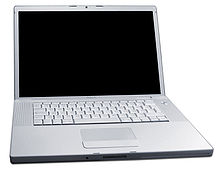
The MacBook Pro (15.4" widescreen) was Apple's first laptop with an Intel
microprocessor. It was announced in January 2006 and is aimed at the
professional market.At the Worldwide Developers Conference keynote address on
June 6, 2005, Steve Jobs announced that Apple would begin producing Intel-based
Mac computers in 2006.[71] On January 10, 2006, the new MacBook Pro and iMac
became the first Apple computers to use Intel's Core Duo CPU. By August 7, 2006
Apple had transitioned the entire Mac product line to Intel chips, over 1 year
sooner than announced.[71] The Power Mac, iBook, and PowerBook brands were
retired during the transition; the Mac Pro, MacBook, and MacBook Pro became
their respective successors.[72][73]. On April 29, 2009, The Wall Street Journal
reported that Apple was building its own team of engineers to design
microchips.[74]
Apple also introduced Boot Camp to help users install Windows XP or Windows
Vista on their Intel Macs alongside Mac OS X.[75]
Apple's success during this period was evident in its stock price. Between early
2003 and 2006, the price of Apple's stock increased more than tenfold, from
around $6 per share (split-adjusted) to over $80. In January 2006, Apple's
market cap surpassed that of Dell.[76] Nine years prior, Dell's CEO Michael Dell
said that if he ran Apple he would "shut it down and give the money back to the
shareholders."[77]
Although Apple's market share in computers has grown, it remains far behind
competitor Microsoft, with only about 8 percent of desktops and laptops in the
U.S.[78]
Delivering his keynote at the Macworld Expo on January 9, 2007, Jobs announced
that Apple Computer, Inc. would from that point on be known as Apple Inc. The
event also saw the announcement of the iPhone and the Apple TV.[79] The
following day, Apple shares hit $97.80, an all-time high at that point. In May,
Apple's share price passed the $100 mark.[80]
On February 6, 2007, Apple indicated that it would sell music on the iTunes
Store without DRM (which would allow tracks to be played on third-party players)
if record labels would agree to drop the technology.[81] On April 2, 2007, Apple
and EMI jointly announced the removal of DRM technology from EMI's catalog in
the iTunes Store, effective in May.[82]
On July 11, 2008, Apple launched the App Store to sell third-party applications
for the iPhone and iPod Touch.[83] Within a month, the store sold 60 million
applications and brought in $1 million daily on average, with Jobs speculating
that the App Store could become a billion-dollar business for Apple.[84] Three
months later, it was announced that Apple had become the third-largest mobile
handset supplier in the world due to the popularity of the iPhone.[85]
On December 16, 2008, Apple announced 2009 would be the last year Apple would be
attending the Macworld Expo, and that Phil Schiller would deliver the 2009
keynote in lieu of the expected Jobs.[86]
On January 14, 2009, an internal Apple memo from Jobs announced that he would be
taking a six-month leave of absence, until the end of June 2009, to allow him to
better focus on his health and to allow the company to better focus on its
products.[87] Despite Jobs' absence, Apple recorded its best non-holiday quarter
(Q1 FY 2009) during the recession with a revenue of $8.16 billion and a profit
of $1.21 billion.[88]
Current products
See also: Timeline of Apple products and List of products discontinued by Apple
Inc.
Mac and accessories
See also: Timeline of Macintosh models, List of Macintosh models grouped by CPU
type, and List of Macintosh models by case type
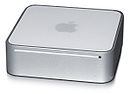
The Mac mini, least-cost desktop computer.Mac mini, consumer sub-desktop
computer and server introduced in January 2005.
iMac, consumer all-in-one desktop computer that was first introduced by Apple in
1998. Its popularity helped revive the company's fortunes.[57]
Mac Pro, workstation-class desktop computer introduced in August 2006. It
replaced the Power Macintosh.
MacBook, consumer notebook introduced in 2006. It replaced the iBook.
MacBook Air, ultra-thin, ultra-portable notebook, introduced in January 2008.
MacBook Pro, professional portable computer alternative to the MacBook,
available in 13, 15, and 17-inch variants, introduced in January 2006. It
replaced the PowerBook.
Xserve, rack mounted, dual or quad core, dual processor 1U server.
Apple sells a variety of computer accessories for Mac computers including the
AirPort wireless networking products, Time Capsule, Cinema Display, Magic Mouse,
the Apple Wireless Keyboard computer keyboard, and the Apple USB Modem.
iPad
Main article: iPad
On January 27, 2010, Apple introduced their much-anticipated media tablet, the
iPad running iPhone OS. It offers multitouch interaction with multimedia formats
including newspapers, magazines, ebooks, textbooks, photos, movies, TV shows
videos, music, word processing documents, spreadsheets, video games, and all
existing iPhone apps.[89] It also includes a mobile version of Safari for
internet browsing, as well as access to the App store, iTunes Library, iBooks
store, contacts, and notepad. Content is downloadable via WIFI and optional 3G
service or synced through the user's computer.[2]AT&T is currently the sole
provider of 3G wireless access for the iPad.[90]
iPod
Main article: iPod
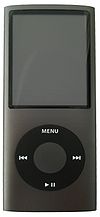
iPod NanoOn October 23, 2001, Apple introduced the iPod digital music player. It
has evolved to include various models targeting the wants of different users.
The iPod is the market leader in portable music players by a significant margin,
with more than 220 million units shipped as of September 9, 2009.[91] Apple has
partnered with Nike to offer the Nike+iPod Sports Kit enabling runners to
synchronize and monitor their runs with iTunes and the Nike+ website. Apple
currently sells four variants of the iPod.
iPod Classic (previously named iPod from 2001 to 2007), portable media player
first introduced in 2001, currently available in a 160 GB model.
iPod Nano, portable media player first introduced in 2005, currently available
in 8 and 16 GB models. The newest generation has a 640x480 video camera (H.264,
30FPS) and an FM tuner with live pause and iTunes Tagging.
iPod Shuffle, digital audio player first introduced in 2005, currently available
in 2 and 4 GB models.
iPod Touch, portable media player first introduced in September 2007. Currently
available in 8, 32, and 64GB models. The 32 and 64GB Gen 3 models feature a
faster processor and include voice control and an external microphone.
iPhone
Main article: iPhone
File:IPhone.png
iPhone 3GSAt the Macworld Conference & Expo in January 2007, Steve Jobs revealed
the long anticipated[92] iPhone, a convergence of an Internet-enabled smartphone
and iPod.[93] The original iPhone combined a 2.5G quad band GSM and EDGE
cellular phone with features found in hand held devices, running a scaled-down
versions of Apple's Mac OS X (dubbed iPhone OS), with various Mac OS X
applications such as Safari and Mail. It also includes web-based and Dashboard
apps such as Google Maps and Weather. The iPhone features a 3.5-inch (89 mm)
touch screen display, 4, 8, or 16 GB of memory, Bluetooth, and Wi-Fi (both "b"
and "g").[93] The iPhone first became available on June 29, 2007 for $499 (4 GB)
and $599 (8 GB) with an AT&T contract.[94] On February 5, 2008, Apple updated
the original iPhone to have 16 GB of memory, in addition to the 8 GB and 4 GB
models[95]. On June 9, 2008, at WWDC 2008, Steve Jobs announced that the iPhone
3G would be available on July 11, 2008.[96] This version added support for 3G
networking, assisted-GPS navigation, and a price cut to $199 for the 8 GB
version, and $299 for the 16 GB version, which was available in both black and
white. The new version was visually different from its predecessor in that it
eliminated the flat silver back, and large antenna square for a curved glossy
black or white back. Following complaints from many people, the headphone jack
was changed from a recessed jack to a flush jack to be compatible with more
styles of headphones. The software capabilities changed as well, with the
release of the new iPhone came the release of Apple's App Store; the store
provided applications for download that were compatible with the iPhone. On
April 24, 2009, the App Store surpassed one billion downloads.[97] On June 8,
2009, at Apple's annual worldwide developers conference, the iPhone 3GS was
announced, providing an incremental update to the device including faster
internal components, support for faster 3G speeds, video recording capability,
and voice control.
iPhone 3G, currently available in an 8 GB model.
iPhone 3GS, currently available in 16 and 32 GB models.
Apple TV
Main article: Apple TV
At the 2007 Macworld conference, Jobs demonstrated the Apple TV, (previously
known as the iTV),[98] a set-top video device intended to bridge the sale of
content from iTunes with high-definition televisions. The device links up to a
user's TV and syncs, either via Wi-Fi or a wired network, with one computer's
iTunes library and streams from an additional four. The Apple TV originally
incorporated a 40 GB hard drive for storage, includes outputs for HDMI and
component video, and plays video at a maximum resolution of 720p.[99] On May 31,
2007 a 160 GB drive was released alongside the existing 40 GB model[100] and on
January 15, 2008 a software update was released, which allowed media to be
purchased directly from the Apple TV.[101] In September 2009, Apple discontinued
the original 40GB Apple TV and now continues to produce and sell the 160GB Apple
TV.
Software
See also: List of Macintosh software
Apple develops its own operating system to run on Macs, Mac OS X, the latest
version being Mac OS X v10.6 Snow Leopard. Apple also independently develops
computer software titles for its Mac OS X operating system. Much of the software
Apple develops is bundled with its computers. An example of this is the
consumer-oriented iLife software package that bundles iDVD, iMovie, iPhoto,
iTunes, GarageBand, and iWeb. For presentation, page layout and word processing,
iWork is available, which includes Keynote, Pages, and Numbers. iTunes,
QuickTime media player, Safari web browser, and Software Update are available as
free downloads for both Mac OS X and Windows.
Apple also offers a range of professional software titles. Their range of server
software includes the operating system Mac OS X Server; Apple Remote Desktop, a
remote systems management application; WebObjects, Java EE Web application
server; and Xsan, a Storage Area Network file system. For the professional
creative market, there is Aperture for professional RAW-format photo processing;
Final Cut Studio, a video production suite; Logic, a comprehensive music toolkit
and Shake, an advanced effects composition program.
Apple also offers online services with MobileMe (formerly .Mac) that bundles
personal web pages, email, Groups, iDisk, backup, iSync, and Learning Center
online tutorials. MobileMe is a subscription-based internet suite that
capitalizes on the ability to store personal data on an online server and
thereby keep all web-connected devices in sync.[102] Announced at MacWorld Expo
2009, iWork.com allows iWork users to upload documents for sharing and
collaboration.
Timeline of Apple products
See also: Timeline of Apple products, Timeline of Apple II family, and Timeline
of Macintosh models
Products on this timeline indicate introduction dates only and not necessarily
discontinued dates, as new products begin on a contiguous product line.
Culture
Corporate
Apple was one of several highly successful companies founded in the 1970s that
bucked the traditional notions of what a corporate culture should look like in
terms of organizational hierarchy (flat versus tall, casual versus formal
attire, etc.). Other highly successful firms with similar cultural aspects from
the same period include Southwest Airlines and Microsoft. Originally, the
company stood in opposition to staid competitors like IBM more or less by
default, thanks to the influence of its founders; Steve Jobs often walked around
the office barefoot even after Apple was a Fortune 500 company. By the time of
the "1984" TV ad, this trait had become a key way the company attempts
differentiated itself from its competitors.[103]
As the company has grown and been led by a series of chief executives, each with
his own idea of what Apple should be, some of its original character has
arguably been lost, but Apple still has a reputation for fostering individuality
and excellence that reliably draws talented people into its employ, especially
after Jobs' return. To recognize the best of its employees, Apple created the
Apple Fellows program. Apple Fellows are those who have made extraordinary
technical or leadership contributions to personal computing while at the
company. The Apple Fellowship has so far been awarded to a few individuals
including Bill Atkinson,[104] Steve Capps,[105] Rod Holt,[104] Alan
Kay,[106][107] Guy Kawasaki,[106][108] Al Alcorn,[109] Don Norman,[106] Rich
Page,[104] and Steve Wozniak.[104]
Users
According to surveys by J. D. Power, Apple has the highest brand and repurchase
loyalty of any computer manufacturer. While this brand loyalty is considered
unusual for any product, Apple appears not to have gone out of its way to create
it. At one time, Apple evangelists were actively engaged by the company, but
this was after the phenomenon was already firmly established. Apple evangelist
Guy Kawasaki has called the brand fanaticism "something that was stumbled
upon".[110] Apple has, however, supported the continuing existence of a network
of Mac User Groups in most major and many minor centers of population where Mac
computers are available.
Mac users meet at the European Apple Expo and the San Francisco Macworld
Conference & Expo trade shows where Apple traditionally introduced new products
each year to the industry and public. Mac developers in turn gather at the
annual Apple Worldwide Developers Conference.
Apple Store openings can draw crowds of thousands, with some waiting in line as
much as a day before the opening or flying in from other countries for the
event.[111] The New York City Fifth Avenue "Cube" store had a line as long as
half a mile; a few Mac fans took the opportunity of the setting to propose
marriage.[112] The Ginza opening in Tokyo was estimated in the thousands with a
line exceeding eight city blocks.[113]
John Sculley told The Guardian newspaper in 1997: "People talk about technology,
but Apple was a marketing company. It was the marketing company of the
decade."[114]
Market research indicates that Apple draws its customer base from an unusually
artistic, creative, and well-educated population, which may explain the
platform’s visibility within certain youthful, avant-garde subcultures.[115]
Corporate affairs
See also: List of mergers and acquisitions by Apple, Braeburn Capital, and
FileMaker Inc.
Apple has a history of vertical integration in their products, manufacturing the
hardware on which they pre-install their software.[citation needed]
During the Mac's early history Apple generally refused to adopt prevailing
industry standards for hardware, instead creating their own.[116] This trend was
largely reversed in the late 1990s beginning with Apple's adoption of the PCI
bus in the 7500/8500/9500 Power Macs. Apple has since adopted USB, AGP,
HyperTransport, Wi-Fi, and other industry standards in its computers and was in
some cases a leader in the adoption of standards such as USB.[117] FireWire is
an Apple-originated standard that has seen widespread industry adoption after it
was standardized as IEEE 1394.[118]
Ever since the first Apple Store opened, Apple has sold third party
accessories.[119] This allows, for instance, Nikon and Canon to sell their
Mac-compatible digital cameras and camcorders inside the store. Adobe, one of
Apple's oldest software partners,[120] also sells its Mac-compatible software,
as does Microsoft, who sells Microsoft Office for the Mac. Books from John Wiley
& Sons, who publishes the For Dummies series of instructional books, are a
notable exception, however. The publisher's line of books were banned from Apple
Stores in 2005 because Steve Jobs disagreed with their editorial policy.[121]
Headquarters
Main article: Infinite Loop (street)
Apple Inc., 1 Infinite Loop, Cupertino, CA.Apple Inc.'s world corporate
headquarters are located in the middle of Silicon Valley, at 1 Infinite Loop,
Cupertino, California. This Apple campus has six buildings that total 850,000
square feet (79,000 m2) and was built in 1993 by Sobrato Development Cos.[122]
In 2006, Apple announced its intention to build a second campus on 50 acres
(200,000 m2) assembled from various contiguous plots. The new campus, also in
Cupertino, will be about 1 mile (1.6 km) east of the current campus.[123]
CEOs
1977–1981: Michael "Scotty" Scott
1981–1983: A. C. "Mike" Markkula
1983–1993: John Sculley
1993–1996: Michael Spindler
1996–1997: Gil Amelio
1997–present: Steve Jobs (Interim CEO 1997–2000)
2004 & 2009: Tim Cook (Acting CEO during Steve Jobs health issues)
Directors
See also: Category:Directors of Apple Inc.
Bill Campbell, Chairman of Intuit Inc.
Millard Drexler, Chairman and CEO of J.Crew
Al Gore, Former Vice President of the United States
Steve Jobs, CEO and Co-founder of Apple; also a director of The Walt Disney
Company
Andrea Jung, Chairman and CEO of Avon Products
Arthur D. Levinson, Chairman and CEO of Genentech
Jerry York, Chairman, President, and CEO of Harwinton Capital
Executives
See also: Category:Apple Inc. executives
Steve Jobs, Chief Executive Officer
Timothy D. Cook, Chief Operating Officer
Peter Oppenheimer, Chief Financial Officer
Philip W. Schiller, Senior Vice President of Worldwide Product Marketing
Mark Papermaster, Senior Vice President of Devices Hardware Engineering
Jonathan Ive, Senior Vice President of Industrial Design
Bertrand Serlet, Senior Vice President of Software Engineering
Ron Johnson, Senior Vice President of Retail
Sina Tamaddon, Senior Vice President of Applications
Scott Forstall, Senior Vice President of iPhone Software
Bob Mansfield, Senior Vice President Mac Hardware
Daniel Cooperman, General Counsel and Secretary
Employees
See also: Category:Apple Inc. employees
Since formation of the Apple Computer Company in 1977, it (as Apple Computer,
Inc.) has employed over 75,000 people worldwide. The majority of Apple's
employees have been located in the United States but Apple has substantial
manufacturing, sales, marketing, and support organizations worldwide, with some
engineering operations in Paris and Tokyo.
Apple employees include employees of companies acquired by Apple as well as
subsidiaries such as FileMaker Inc. and Braeburn Capital.
Advertising
Main article: Apple Inc. advertising
Further information: Think Different, Get a Mac, and Apple Switch ad campaign
Since the introduction of the Macintosh in 1984 with the 1984 Super Bowl
commercial to the more modern 'Get a Mac' adverts, Apple has been recognized in
the past for its efforts towards effective advertising and marketing for its
products, though its advertising has been criticized for the claims of some more
recent campaigns, particularly 2005 Power Mac ads[124][125][126] and iPhone ads
in Britain.
Logos
See also: U+F8FF or , seen as the Apple logo in some fonts.
Apple’s first logo, designed by Jobs and Wayne, depicts Sir Isaac Newton sitting
under an apple tree. Almost immediately, though, this was replaced by Rob
Janoff’s “rainbow Apple”, the now-familiar rainbow-colored silhouette of an
apple with a bite taken out of it. Janoff presented Jobs with several different
monochromatic themes for the "bitten" logo, and Jobs immediately took a liking
to it. While Jobs liked the logo, he insisted it be in color, as a way to
humanize the company.[127][128] The Apple logo was designed with a bite so that
it would be recognized as an apple rather than a cherry. The colored stripes
were conceived to make the logo more accessible, and to represent the fact the
monitor could reproduce images in color.[129]
In 1998, with the roll-out of the new iMac, Apple discontinued the rainbow theme
and began to use monochromatic themes, nearly identical in shape to its previous
rainbow incarnation.
The original Apple logo featuring Isaac Newton under the fabled apple tree.
The rainbow "bitten" logo, used from late 1976 until replaced in 1998 by
monochrome themes.
The monochrome-themed logo maintained the same shape as the rainbow theme it
replaced. It is still used and often appears in various colors on various
products, such as packaging and advertisements in 2003. An Aqua themed version
of this logo was used from 2001 through 2003, and a "glass" themed version from
2003 on.
Slogans
Main article: List of Apple Inc. slogans
Apple's first slogan, "Byte into an Apple", was coined in the late 1970s.[130]
From 1997–2002, Apple used the slogan Think Different in advertising campaigns.
The slogan had a lasting impact on their image and revived their popularity with
the media and customers. Although the slogan has been retired, it is still
closely associated with Apple.[131] Apple also has slogans for specific product
lines — for example, "iThink, therefore iMac" was used in 1998 to promote the
iMac,[132] and "Say hello to iPhone" has been used in iPhone
advertisements.[133] "Hello" was also used to introduce the original Macintosh,
Newton, iMac ("hello (again)"), and iPod.[134]
Commercials
See also: 1984 (advertisement), Lemmings (advertisement), iPod advertising, and
music used by Apple Inc.
Apple’s product commercials are notorious for launching musicians into stardom
as a result of their eye-popping graphics and catchy tunes.[135] First, the
company popularized Canadian singer Feist’s “1234” song in its ad campaign.[135]
Then Apple used the song “New Soul” by French-Israeli singer-songwriter Yael
Naim to promote the MacBook Air.[135] The debut single shot to the top of the
charts and sold hundreds of thousands of copies in a span of weeks.[135]
Environmental record
Greenpeace, an environmentalist organization, has confronted Apple on various
environmental issues, including promoting a global end-of-life take-back plan,
non-recyclable hardware components, and toxins within the iPhone
hardware.[136][137] Since 2003 they have campaigned against Apple regarding
their chemical policies, in particular the inclusion of PVC and BFRs in their
products, both of which have serious negative health effects.[136] On May 2,
2007, Steve Jobs released a report announcing plans to completely eliminate PVC
and BFRs by the end of 2008.[138][139]
Greenpeace runs a "Guide to Greener Electronics", which rates companies on
chemical-disposal waste-reduction practices. In the first edition, released in
August 2006, Apple scored 2.7/10.[140] In subsequent editions Apple's score has
improved steadily.[141][142][143][144] Apple has soon improved its score to a
4.1/10, placing it in the 45th percentile among 17 other electronic companies
and 10th in the rankings.[145]
At the 2007 Macworld Expo, Greenpeace presented a critique of Apple. Rick Hind,
the legislative director of Greenpeace's toxics campaign, said, "(The company)
is getting greener, but not green enough." Hind commented further, "The Macbook
Air has less toxic PVC plastic and less toxic BFRs, but it could have zero and
that would make Apple an eco-leader."[146]
In May 2008, Climate Counts, a nonprofit organization dedicated to directing
consumers toward the greenest companies, gave Apple 11 points out of a possible
100, which placed the company last among electronics companies. Climate Counts
also labeled Apple with a "stuck icon," and the environmental group added that
Apple was "a choice to avoid for the climate conscious consumer."[147]
The Environmental Protection Agency rates Apple highest amongst producers of
notebook computers, and fairly well compared to producers of desktop computers
and LCD displays.[148][149]
In June 2007 Apple upgraded the MacBook Pro, replacing cold cathode fluorescent
lamp (CCFL) backlit LCD displays with mercury-free LED backlit LCD displays and
arsenic-free glass,[150] and has since done this for all notebooks. Apple has
also phased out BFRs and PVCs from various internal components.[138][151][152]
Apple also offers detailed information about the emissions, materials, and
electrical usage of each product.[153] Apple has also begun to advertise how
environmentally friendly their new laptops are with television spots and
magazine ads along with stating these facts on their website.[citation needed]
In June 2009 Apple's iPhone 3GS was free of PVC, arsenic, BFR's and had an
efficient power adapter.[154]
In October 2009 Apple upgraded the iMac and MacBook, replacing the cold cathode
fluorescent lamp (CCFL) backlit LCD displays with mercury-free LED backlit LCD
displays and arsenic-free glass.[155] This means all Apple computers have
mercury free LED backlit displays, arsenic-free glass and are without PVC
cables. All Apple computers also have EPEAT Gold status.[154]
Labor practices
In 2006, the Mail on Sunday alleged that sweatshop conditions existed in
factories in China, where the contract manufacturers, Foxconn and Inventec
operate the factories that produce the iPod.[156]
The article stated that one iPod factory, for instance, had over 200,000 workers
that lived and worked in the factory, with workers regularly doing more than 60
hours of labor per week. The article also reported that workers made around $100
per month were required to live on the premises and pay for rent and food from
the company. Living expenses (required to keep the job) generally took up a
little over half of the worker's earnings. The article also said that workers
were given buckets to wash their clothes.[157][158][159]
Immediately after the allegations, Apple launched a full investigation and
worked with their manufacturers to ensure that conditions were acceptable to
Apple.[160]
Criticism
Main article: Criticism of Apple
Apple has been criticized from both user and developer perspectives over
disabling Google Voice from their online store for iPhone,[161] pressuring
journalists to reveal their sources regarding future Apple products,[162]
restrictive and long wait in approving or disapproving third party iPhone
software, disabling iTunes syncing with third-party devices like Palm Pre, and
the iPhone's US exclusivity with AT&T, along with questions and concerns about
other app rejections and the general approval process for the iPhone's App
Store.[163] Philip W. Schiller, senior vice president of Apple's Worldwide
Product Marketing, has tried to address many of the App Store concerns by
sending letters to the respective developers.[163]
References
^ a b Linzmayer, Ronald W. (1999). Apple Confidential: The Real Story of Apple
Computer, Inc.. No Starch Press.
http://extras.denverpost.com/books/chap0411h.htm.
^ a b c "Apple Tablet Media Event Today: "Come See Our Latest Creation"".
MacRumors. January 27, 2010.
http://www.macrumors.com/2010/01/27/apple-tablet-media-event-today-come-see-our-latest-creation/.
Retrieved January 27, 2010.
^ a b c d "Revised Request Quarterly Income Statement". Apple Inc.. January 25,
2010.
http://phx.corporate-ir.net/External.File?item=UGFyZW50SUQ9Mjc1MjN8Q2hpbGRJRD0tMXxUeXBlPTM=&t=1.
Retrieved January 25, 2010.
^ a b c "Revised Quarterly Balance Sheet Information". Apple Inc.. January 25,
2010.
http://phx.corporate-ir.net/External.File?item=UGFyZW50SUQ9Mjc1MjV8Q2hpbGRJRD0tMXxUeXBlPTM=&t=1.
Retrieved January 25, 2010.
^ http://www.google.com/finance?q=aapl
^ "Apple Store—Store List". Apple Inc.. http://www.apple.com/retail/storelist/.
Retrieved January 27, 2010.
^ a b Apple Investor Relations FAQ, Apple. Retrieved on March 2, 2007.
^ "Form 8-K SEC Filing" (pdf). January 10, 2007.
http://ccbn.10kwizard.com/cgi/convert/pdf/APPLEINC8K.pdf?pdf=1&repo=tenk&ipage=4589126&num=-2&pdf=1&xml=1&cik=320193&odef=8&rid=12&quest=1&dn=2&dn=3.
Retrieved December 8, 2007.
^ Markoff, John (January 9, 2007). "New Mobile Phone Signals Apple’s Ambition".
The New York Times.
http://www10.nytimes.com/2007/01/09/technology/09cnd-iphone.html?_r=5&ref=technology&oref=slogin&oref=slogin&oref=slogin&oref=slogin.
Retrieved January 9, 2007.
^
http://seekingalpha.com/article/115797-apple-inc-f1q09-qtr-end-12-27-08-earnings-call-transcript?source=front_page_transcripts&page=-1
^ "Apple, Google tops in loyalty survey". MacNN. July 11, 2006.
http://www.macnn.com/articles/06/07/11/apple.google.find.loyalty/. Retrieved
August 18, 2008.
^ Fisher, Anne (March 17, 2008). "America's Most Admired Companies". Fortune 157
(5): 65–67.
http://money.cnn.com/galleries/2008/fortune/0802/gallery.mostadmired_top20.fortune/index.html.
^ Colvin, Geoff (March 16, 2009). "The World's Most Admired Companies 2009".
Fortune 159 (5): 76.
^ IOL Technology – Co-founder tells his side of Apple story
^ NPR : A Chat with Computing Pioneer Steve Wozniak
^ Wozniak, Stephen. Homebrew and How the Apple Came to Be, Digital Deli.
Retrieved on March 2, 2007.
^ Kahney, Leander. Rebuilding an Apple From the Past, Wired, November 19, 2002.
^ "Consumer Price Index (estimate) 1800–2008". Federal Reserve Bank of
Minneapolis.
http://www.minneapolisfed.org/community_education/teacher/calc/hist1800.cfm.
Retrieved August 1, 2009.
^ BBC News: History of Technology. Accessed January 19, 2008.
^ Computer History Museum (ComputerHistory.org). Accessed January 19, 2008.
^ Game Makers (TV Show): Apple II. Originally aired January 6, 2005.
^ Picture of original ad featuring US666.66 price
^ Wozniak, Steven: "iWoz", page 180. W. W. Norton, 2006. ISBN 978-0-393-06143-7
^ "Apple Chronology". Fortune. CNN. January 6, 1998.
http://money.cnn.com/1998/01/06/technology/apple_chrono/. Retrieved September
11, 2008.
^ "Apple Inc." MSN Encarta. Retrieved on March 2, 2007. Archived October 31,
2009.
^ Steven Weyhrich (April 21, 2002). "Apple II History Chapter 4".
http://apple2history.org/history/ah04.html. Retrieved August 18, 2008.
^ a b Hormby, Thomas. VisiCalc and the rise of the Apple II, Low End Mac,
September 22, 2006. Retrieved on March 2, 2007.
^ Bagnall, Brian (2005). On the Edge: The Spectacular Rise and Fall of
Commodore. Variant Press. pp. 109–112. ISBN 0973864907.
^ Personal Computer Market Share: 1975–2004 The figures show Mac higher, but
that is not a single model.
^ Coventry, Joshua. Apple III Chaos: What Happened When Apple Tried to Enter the
Business Market, Low End Mac, September 1, 2006. Retrieved on March 2, 2007.
^ Fool.com: How Xerox Forfeited the PC War [Fool on the Hill] September 18,
2000. Retrieved August 12, 2008.
^ Apple at 30 – 1976 to 1986 | World of Apple. Retrieved August 12, 2008.
^ Hormby, Thomas. A history of Apple's Lisa, 1979–1986, Low End Mac, October 6,
2005. Retrieved on March 2, 2007.
^ Apple's 1984: The Introduction of the Macintosh in the Cultural History of
Personal Computers
^ Apple's '1984' Super Bowl commercial still stands as watershed event
^ Leopold, Todd (February 3, 2006). "Why 2006 isn't like '1984'". CNN.
http://edition.cnn.com/2006/SHOWBIZ/02/02/eye.ent.commercials/. Retrieved May
10, 2008.
^ Cellini, Adelia (January 2004). "The Story Behind Apple's '1984' TV
commercial: Big Brother at 20". Macworld 21.1, page 18.
http://findarticles.com/p/articles/mi_hb197/is_200401/ai_n5556112. Retrieved May
9, 2008.
^ a b Hormby, Thomas. Good-bye Woz and Jobs: How the first Apple era ended in
1985, Low End Mac, October 2, 2006. Retrieved on March 2, 2007.
^ When was desktop publishing invented? Retrieved on April 30, 2007.
^ a b Hormby, Thomas. Growing Apple with the Macintosh: The Sculley years, Low
End Mac, February 22, 2006. Retrieved on March 2, 2007.
^ Spector, G (September 24, 1985). "Apple's Jobs Starts New Firm, Targets
Education Market". PC Week: p. 109.
^ Hormby, Thomas. Birth of the PowerBook: How Apple took over the portable
market in 1991, Low End Mac, November 23, 2005. Retrieved on March 2, 2007.
^ Apple II History Chap 11. Retrieved August 12, 2008.
^ Apple II History Chap 11. Retrieved August 12, 2008.
^ 1990–1995: Why the World Went Windows. Retrieved August 12, 2008.
^ Hormby, Thomas. The Apple vs. Microsoft GUI lawsuit, Low End Mac, August 25,
2006. Retrieved on March 2, 2007.
^ Michael Spindler: The Peter Principle at Apple. Retrieved August 12, 2008.
^ 1990–1995: Hitting the Wall. Retrieved August 14, 2008.
^ Power Macintosh 6100. Retrieved August 12, 2008.
^ Chaffin, Bryan. "Former Apple CEO Gil Amelio Lands A New CEO Job || The Mac
Observer", The Mac Observer, February 6, 2001. Retrieved August 15, 2008.
^ Apple Computer, Inc. Finalizes Acquisition of NeXT Software Inc., Apple Inc.,
February 7, 1997. Retrieved on June 25, 2006.
^ Microsoft and Apple Affirm Commitment to Build Next Generation Software for
Macintosh, Apple Inc., August 6, 1997.
^ Harreld, Heather. "Apple gains tech, agency customers in Next deal", Federal
Computer Week, January 5, 1997. Retrieved August 15, 2008.
^ "Apple unveils new marketing strategy. | Knight Ridder/Tribune News Service
(November, 1997)". Retrieved August 15, 2008.
^ Grossman, Lev. The Apple Of Your Ear, TIME, January 12, 2007. Retrieved on
February 1, 2007.
^ Wilson, Greg. [Private iCreator is genius behind Apple's polish, New York
Daily News, January 14, 2007. Retrieved on February 1, 2007.
^ a b 800,000 iMacs Sold in First 139 Days. Retrieved August 15, 2008.
^ Sarkar, Pia. "Friends and Foes/ Despite squabbles, Apple and Adobe have
benefited from one another", SFGate, February 25, 2002. Retrieved August 15,
2008.
^ Sandoval, Greg (April 15, 2007). "Apple exhibits Final Cut Studio 2". CNet.
http://news.cnet.com/2100-1046-6176170.html?hhTest=1. Retrieved December 4,
2007.
^ Chaffin, Bryan. "Apple Shake: Apple Buys Nothing Real, A High End Compositing
Software Maker || The Mac Observer", The Mac Observer, February 7, 2002.
Retrieved August 15, 2008.
^ Apple Acquires Emagic, Apple, July 1, 2002. Retrieved August 15, 2008.
^ Deitrich, Andy. Garage Band: Part 1, ars technica, February 2, 2004. Retrieved
August 15, 2008.
^ Apple Introduces iPhoto, Apple Inc., January 7, 2002. Retrieved August 15,
2008.
^ Apple – Support – Mac OS X v10.4 Tiger Classic Environment
^ ifo Apple Store – Apple Stores 2001–2003
^ Apple enjoys ongoing iPod demand, BBC News, January 18, 2006. Retrieved on
April 27, 2007.
^ Cantrell, Amanda. Apple's remarkable comeback story, CNN, March 29, 2006.
Retrieved on March 2, 2007.
^ iTunes Store Tops Five Billion Songs, Apple Inc., June 19, 2008. Retrieved on
September 3, 2008.
^ "Apple revamps iBook. | Network World (May, 2001)", Network World, May 2,
2001. Retrieved August 19, 2008.
^ Magee, Mike. "iMac "All-in-One" is a trinity – The INQUIRER", The Inquirer,
January 26, 2002. Retrieved August 19, 2008.
^ a b Apple to Use Intel Microprocessors Beginning in 2006, Apple Inc., June 6,
2005. Retrieved on March 2, 2007.
^ Power Mac to Mac Pro
^ Apple Unveils New MacBook Featuring Intel Core Duo Processors
^ http://online.wsj.com/article/SB124104666426570729.html
^ Hesseldahl, Arik (April 5, 2006). "News Flash: Apple Introduces "Boot Camp" To
Run Windows XP on Macs". BusinessWeek.
http://www.businessweek.com/technology/ByteOfTheApple/blog/archives/2006/04/news_flash_appl.html.
Retrieved August 18, 2008.
^ Gamet, Jeff. Apple Passes Dell's Market Cap, MacObserver, January 16, 2006.
Retrieved on March 2, 2007.
^ Singh, Jal. Dell: Apple should close shop, CNET News, October 6, 1997.
Retrieved on March 2, 2007.
^ http://www.nytimes.com/2009/08/30/business/media/30ad.html?em
^ Apple – Hot News – Macworld 2007
^ AAPL surges past $100, target at $140, MacNN, April 26, 2007. Retrieved on
July 10, 2007.
^ Jobs, Steve. Thoughts on Music, Apple Inc., February 6, 2007. Retrieved on
March 2, 2007.
^ Jim Dalrymple. Apple, EMI offer higher-quality DRM free downloads, Playlist
Magazine, February 6, 2007. Retrieved on April 7, 2007.
^ Flandez, Raymund. "Programmers Jockey for iPhone Users at Apple Site", The
Wall Street Journal. Retrieved August 16, 2008.
^ McLaughlin, Kevin. "Apple's Jobs Gushes Over App Store Success – The Channel
Wire – IT Channel News And Views by CRN and VARBusiness", ChannelWeb, August 11,
2008. Retrieved August 16, 2008.
^ Chen, Brian (February 26, 2009). "Why the Japanese Hate the iPhone". Mac Life.
http://blog.wired.com/gadgets/2009/02/why-the-iphone.html. Retrieved March 1,
2009.
^ "Chunkier sidekick to replace Jobs at Macworld", DoesWhat. Retrieved December
16, 2008.
^ "Apple Media Advisory". Apple. January 14, 2009.
http://www.apple.com/pr/library/2009/01/14advisory.html. Retrieved January 14,
2009.
^
http://www.wealthalchemist.com/Blog/2009/04/apple-report-best-non-holiday-quarter/
^ "Apple Launches iPad". SunHerald. January 27, 2010.
http://www.sunherald.com/prnewswire/story/1901192.html. Retrieved January 27,
2010.
^ >"AT&T Beefing Up Network for iPad and iPhone". PC World. January 29, 2010.
http://www.pcworld.com/businesscenter/article/188149/atandt_beefing_up_network_for_ipad_and_iphone.html.
Retrieved January 29, 2010.
^ "Liveblog: "Rock and Roll" Apple iPod Event". Ars Technica. September 9, 2009.
http://arstechnica.com/apple/news/2009/09/liveblog-rock-and-roll-apple-ipod-event.ars.
Retrieved September 9, 2009.
^ Apple's Chief in the Risky Land of the Handhelds New York Times
^ a b Apple Reinvents the Phone with iPhone
^ iPhone Premieres This Friday Night at Apple Retail Stores
^ "Apple Adds New iPhone & iPod touch Models". Apple, Inc.. February 5, 2008.
http://www.apple.com/pr/library/2008/02/05iphoneipodtouch.html. Retrieved
September 8, 2009.
^ Apple Introduces the New iPhone 3G
^ http://www.apple.com/pr/library/2009/04/24appstore.html
^ Apple Announces iTunes 7 with Amazing New Features
^ Apple TV Coming to Your Living Room
^ YouTube Coming to Apple TV
^ Apple Introduces New Apple TV Software & Lowers Price to $229
^ "Apple.com — MobileMe — Features". http://www.apple.com/mobileme/features/.
Retrieved August 31, 2008.
^ Apple Corporate Culture
^ a b c d Hertzfeld, Andy. Credit Where Due,Folklore.org, January 1983.
Retrieved on May 26, 2006.
^ Newton Hall of Fame!
^ a b c Eisenhart, Mary. Fighting Back For Mac, MicroTimes, 1997. Retrieved on
May 26, 2006.
^ Hertzfeld, Andy. Leave of Absence,Folklore.org, March 1984. Retrieved on May
26, 2006.
^ Kawakami, John. Apple Taps Guy Kawasaki For Apple Fellows Program, MacTech,
September 1995. Retrieved on May 26, 2006.
^ Wired 4.10: Spawn of Atari
^ Huba, Jackie; McConnell, Ben. The father of evangelism marketing.
^ Apple Store: Chain of Devotion
^ ifo Apple Store – Fifth Avenue Grand Opening
^ JapanConsuming.com: Apple in Osaka
^ Wired News: Apple: It's All About the Brand
^ Fried, Ian. Are Mac users smarter?, news.com, July 12, 2002. Retrieved on
April 24, 2006.
^ Mac Ports
^ Standards and specs: The ins and outs of USB
^ 1394 Trade Association: What is 1394?
^ Apple Marks Second Anniversary of Retail Stores
^ Opinion: Adobe's DNA is part of Apple | Macworld
^ Hafner, Katie: Steve Jobs's Review of His Biography: Ban It, The New York
Times, April 30, 2005.
^ Apple gobbles up Cupertino office space – Silicon Valley / San Jose Business
Journal:
^ "The Bay Area: Apple Inc.". traveldk.com. Dorling Kindersley Limited.
http://traveldk.com/san-francisco/bay-area/member/apple-inc. Retrieved May 7,
2008.
^ BBB Tells Apple to Halt Misleading Ads
^ Apple Power Mac ads 'misleading'
^ UK watchdog clears Apple ads
^ Wired News: Apple Doin' the Logo-Motion
^ ZLOK Logo Design Blog: I Invented ... the Apple Logo
^ Raszl, Ivan. "Interview with Rob Janoff, designer of the Apple logo".
http://creativebits.org/interview/interview_rob_janoff_designer_apple_logo.
^ "Apple Company". Operating System Documentation Project. Operating System
Documentation Project. December 10, 2007.
http://www.operating-system.org/betriebssystem/_english/fa-apple.htm. Retrieved
August 18, 2008.
^ Apple Think Different Campaign | The Inspiration Room Daily. Retrieved August
12, 2008
^ MacWorld New York: I think, therefore iMac. Retrieved August 13, 2008.
^ BillDay.com » Say hello to iPhone. Retrieved August 13, 2008.
^ IMac: What's in a Design, Anyway?. Wired Magazine. Retrieved February 15,
2010.
^ a b c d Farber, Jim. Apple ad creates recognition for Yael Naim, New York
Daily News, March 11, 2008.
^ a b iTox + iWaste. Retrieved August 12, 2008.
^ ABC News: Is the iPhone Toxic? Greenpeace Says So. ABC News. Retrieved August
12, 2008
^ a b Apple – A Greener Apple. Retrieved August 12, 2008
^ Tasty news from Apple!. Greenpeace International. Retrieved August 12, 2008.
^ How the companies line up. Greenpeace International. Retrieved August 12,
2008.
^ How the companies line up: 2nd Edition. Greenpeace International. Retrieved
August 12, 2008.
^ How the companies line up: 3rd Edition. Greenpeace International. Retrieved
August 12, 2008.
^ How the companies line up: 4th Edition Greenpeace International. Retrieved
August 12, 2008.
^ How the companies line up: 6th Edition Greenpeace International. Retrieved
August 12, 2008.
^ Company scores plummet in Greener Electronics Guide Greenpeace USA.
^ Apple's 'Green' Notebook Doesn't Impress Environmentalists. Wired. Retrieved
August 12, 2008.
^ Environmental Group Hits Apple
^ EPA Gives Apple Silver Rating on Environment The Mac Observer.
^ EPA information should make GreenPeace red-faced over Apple targeting, Ars
Technica. Retrieved on January 8, 2007.
^ Jobs, Steve (2008). "Apple — Environment — Apple 2008 Environmental Update".
Apple Inc.. http://www.apple.com/environment/update/. Retrieved December 24,
2008.
^ "Apple — Mac — Green Notebooks". Apple Inc.. 2008.
http://www.apple.com/mac/green-notebooks/. Retrieved December 24, 2008.
^ Apple: MacBook Pro Graphics. Retrieved on June 8, 2007.
^ "Apple — Environment — Resources — Environmental Performance 2008". Apple
Inc.. 2008.
http://www.apple.com/environment/resources/environmentalperformance.html.
Retrieved December 24, 2008.
^ a b "Apple and the Environment: News". http://www.apple.com/environment/news/.
Retrieved February 14, 2010.
^ iMac and the Environment
^ The Start Reality of iPod's Chinese Factories
^ Sweatshop Conditions at IPod Factory Reported
^ Judging Apple Sweatshop Charge
^ The Forbidden City of Terry Gou
^ Apple, IT and the Specter of Sweatshop Labor
^
http://www.techcrunch.com/2009/07/31/fcc-takes-on-apple-and-att-over-google-voice-rejection/
^ Apple v. Does EFF, May 26, 2006. Retrieved on May 14, 2007.
^ a b Neil Hughes (August 19, 2009). "Apple's campaign to win the App Store
publicity battle". AppleInsider.
http://www.appleinsider.com/articles/09/08/19/apples_campaign_to_win_the_app_store_publicity_battle.html.
Retrieved September 8, 2009.
History
Rob Price (1987). "So Far: The First Ten Years of a Vision". Apple Computer.
ISBN 1-55693-974-4.
Ken Polsson. "Chronology of Events in the History of Microcomputers".
http://www.microprocessor.sscc.ru/comphist/. Retrieved August 18, 2008.
"Apple II history". http://apple2history.org/history/appy/ahb2.html. Retrieved
August 18, 2008.
"Apple III history". http://www.oazoo.com. Retrieved August 5, 2006.
Drawings from the Finnish Nature and
Culture
Maalauksia Suomen luonnosta ja
kulttuurista


http://www.kp-art.fi/default.htm
Pelasta elämä - lahjoita verta!
Safe a Life - Donate Blood!